
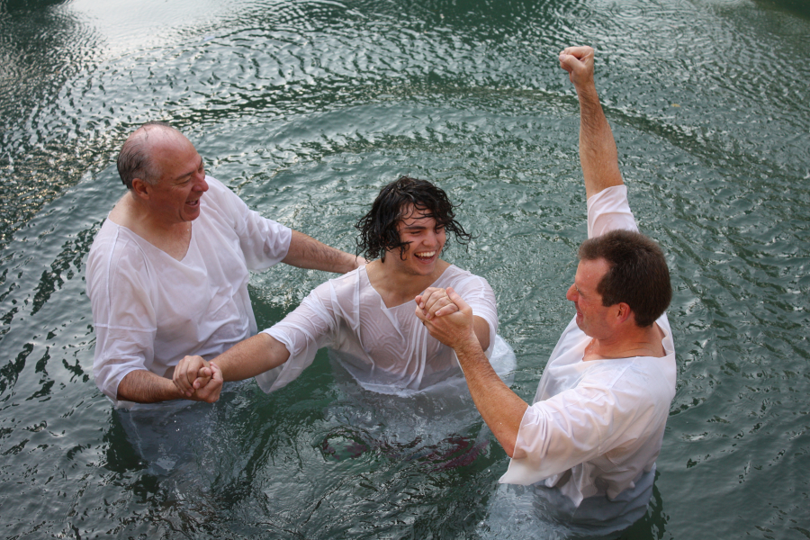
Archaeologists digging near the famous Wailing Wall in Jerusalem just discovered a large mikveh, or ritual bathing pool. You can read about it at Israel finds Second Temple-period mikveh under Western Wall | The Jerusalem Post. Hundreds of ancient mikva’ot have been discovered in Judea, and many modern ones constructed by Jews around the world.
This matters to Baptist Christians because it is yet another piece of evidence in a case we’ve been making for hundreds of years now: in the New Testament, the Greek word baptizein means “immerse” or “sink” or “dip” or “dunk.” In other words, a mere “washing” or “sprinkling” or “pouring” is not a baptism–at least, not by Bible standards. Our English Bibles render the word as “baptize,” but that’s obviously not an actual translation. It’s a transliteration, a moving of a word from one language (and its alphabet) to another, without communicating anything about the actual meaning of the word. From our very beginning, Baptists have been insisting that immersion is the only mode of baptism that really counts as New Testament baptism. There is now very little disagreement about this any more among scholars of koine (New Testament) Greek. The word means” dunk,” plain and simple.
However, preachers can’t seem to stop beating horses long after they are dead. One passage that often shows up in our debates about the matter is Mark 7:4, where Mark refers to the Pharisees’ practice of baptizing pots and cups and dining couches to restore them to ritual purity. One line of argument has been that nobody would immerse a whole couch for purposes of ritual purification. Hence, it is argued, the word baptizein can mean something less than “to immerse.”
However, these ancient mikva’ot say otherwise. The one just discovered in Jerusalem was six feet deep, four and a half feet wide, and nine feet long, and it is nowhere close to the largest one found. Along with the archaeological evidence, there is ample corroboration in the rabbinical literature (the Mishnah and Talmud, from 200-600 AD) that Jews during the first century already had elaborate rituals for washing objects (sometimes large ones), hands, and entire bodies (sometimes several at once) by immersion.
People have asked why we at FBCD ask those who have only been sprinkled or splashed with water to let us dunk them in the name of the Father, Son, and Holy Spirit. We don’t at all see this as re-baptism. The first wetting was not a baptism. It was a sprinkling or splashing. If it wasn’t a dunking, it wasn’t a baptism (at least, not as Jesus and his Apostles saw things}.
Of course, if you look at that passage in Mark very carefully at all, you will see that the whole issue was a complaint from the Pharisees against Jesus’ disciples because they didn’t properly wash their hands (which presumably would have included immersing them in water for full ritual purification). Is it surprising that some have accused us Baptists of being pharisaical about this? No doubt some of us are. We all need to guard our hearts.
The evidence from early church history is that immersion in fresh, even moving, water was the standard mode of baptism, except in extraordinary cases. In those genuine exceptions, when immersion was legitimately impossible, the early churches would accept pouring (as when Novatian was baptized on his deathbed). There is no evidence they ever sprinkled anyone. The original practice of the Christian churches in the first centuries after Christ was not pharisaical; it was faithful — to the commands of Jesus and the teaching of his Apostles that we have in Scripture.